Navigating Waters: Precision Future Climate Projection for Flood & Drought Resilience
Welcome to a nexus of innovation and expertise, where cutting-edge climate model simulations meet real-world challenges. I specialise in fine-scale regional climate modelling, providing essential insights for managing extreme floods and droughts. Join me in exploring how accurate climate projections can safeguard our future against these elemental forces.

About me
I am a water and climate scientist specialising in regional climate modelling, hydrological extremes, and high-resolution weather and climate analysis. I completed my PhD at the Water Research Centre, University of New South Wales, and have since worked across university, government, and multi-institutional research programs in Australia.
My research focuses on understanding how climate variability and climate change influence extreme rainfall, drought, heat, and water availability. I use regional climate models, hydrological modelling, and observational datasets to evaluate local-scale climate risks and improve the reliability of future climate projections.
A central theme of my work is translating complex climate science into practical knowledge. Through this website, I share evidence-based explanations, scientific visualisations, and research insights on water, weather, climate extremes, and environmental change.
My vision
Climate change is reshaping both natural systems and human society. Rising global temperatures influence sea levels, rainfall extremes, drought, water security, energy demand, agriculture, ecosystems, and food production. Understanding these interconnected changes is essential for developing effective adaptation strategies and reducing future climate risks.
My research seeks to improve our understanding of how a warming climate alters extreme rainfall, severe storms, droughts, and other high-impact events. By combining climate modelling, hydrological analysis, and observations, I aim to provide more reliable information at the regional and local scales where planning decisions are made.
My broader vision is to help translate climate science into practical knowledge that supports resilient communities and infrastructure. Better evidence about future extremes can inform the design and management of roads, bridges, buildings, drainage systems, reservoirs, and water resources, helping society prepare for a climate that is increasingly different from the past.

Climate Change
Climate change is placing increasing pressure on natural systems, infrastructure, economies, and communities. These impacts are often most severe in regions with limited capacity to adapt, making reliable climate information and effective adaptation planning increasingly important.
My research examines how climate variability and long-term warming affect water resources, rainfall, drought, and environmental systems. I aim to improve our understanding of regional climate risks and provide scientific evidence that can support climate adaptation, water management, and decision-making in vulnerable regions.
Climate Extremes
A warmer climate can alter the frequency, intensity, duration, and spatial distribution of extreme events, including heavy rainfall, floods, droughts, and heatwaves. Understanding how these events may change is essential because infrastructure and water-management systems have traditionally been designed using observations from a climate that may no longer represent future conditions.
My research investigates the physical characteristics and future behaviour of hydrological and meteorological extremes. The goal is to provide more reliable estimates of extreme-event risk and support the design and management of resilient drainage systems, reservoirs, flood-protection measures, and other critical infrastructure.
Regional Climate Model
Global climate models are essential for understanding large-scale climate change, but their spatial resolution is often too coarse to represent local topography, coastlines, convective processes, and regional rainfall patterns in sufficient detail.
I use regional climate models and high-resolution atmospheric simulations to translate large-scale climate information into more locally relevant projections. My work evaluates how model resolution, physical processes, boundary conditions, and observational uncertainty influence the simulation of rainfall and climate extremes.
By improving the representation of regional climate processes, this research helps produce more credible information for infrastructure design, water resource planning, climate risk assessment, and adaptation.
Open-Source Tools and Applications
I develop reproducible, open-source tools that improve the analysis and application of climate-model simulations. One of my major research contributions is a Python-based framework designed to correct systematic biases in the atmospheric boundary conditions used by regional climate models.
The framework incorporates large-scale climate information while preserving relationships among multiple atmospheric variables. This enables researchers to conduct more physically consistent regional climate simulations and evaluate future hydrological extremes with greater confidence.
My broader objective is to make advanced climate-modelling methods more transparent, accessible, and practical for researchers, environmental practitioners, and decision-makers. By combining scientific methodology with reproducible computational tools, I aim to strengthen the connection between climate model development and real-world climate adaptation.
-
Why Is This El Niño Called “Super”? A Story About Rainfall Prediction Uncertainty
Australia is entering the second half of 2026 with El Niño conditions already established and forecasts pointing to further strengthening later in the year. NOAA gives a high chance of a very strong El Niño by October–December, and some media outlets have already started using the word “super.” At the same time, the Bureau of…
-
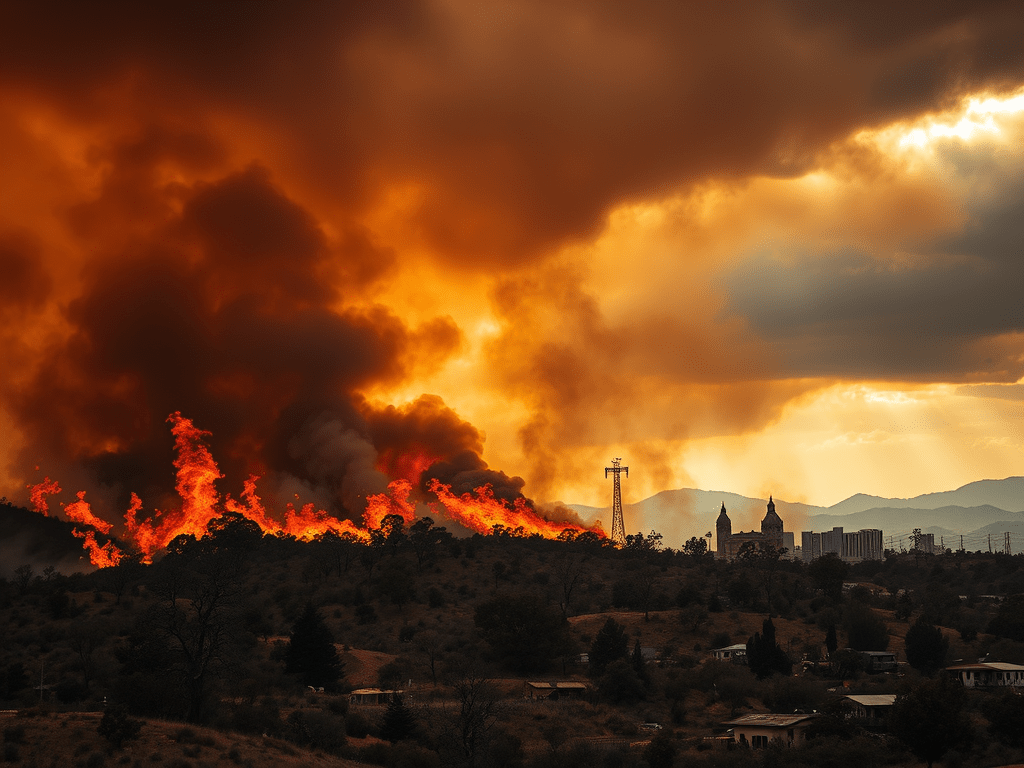
Wildfires in Victoria and LA: Climate Crisis Exposed
Recent wildfire events in Victoria, Australia, and Los Angeles, USA, have highlighted the intensifying frequency and ferocity of fires in a warming world. These incidents serve as stark reminders of the urgent need for global climate action to mitigate the cascading effects of rising temperatures on ecosystems, communities, and economies. Victoria’s Bushfires: A Nation Scorched…
-
Global Climate Models: Our Window to Future Climates
Global Climate Models (GCMs) are sophisticated tools designed to simulate the Earth’s climate systems and predict future changes. These models integrate complex interactions between the atmosphere, oceans, land surface, and ice to project how variables such as greenhouse gas concentrations will influence global climates. Their predictions, crucial for climate policy and adaptation strategies, hinge on…
-
Global Tipping Points: Navigating Earth’s Critical Thresholds
Our planet’s equilibrium is delicate, a balance that, once disrupted, can lead to global tipping points—critical thresholds that, when crossed, result in significant, often irreversible changes. These tipping points are not confined to environmental issues alone but span across ecosystems, economies, and societal structures. Understanding, identifying, and navigating these thresholds is crucial for sustaining life…
-

Cyclone Watch: Far North Queensland Faces Another Weather Challenge
Far North Queensland, a region no stranger to extreme weather events, is once again bracing itself for cyclonic impact. Recent developments in the Coral Sea have raised concerns, and authorities are closely monitoring the situation. Let’s dive into the key details: 1. Tropical Low Could Become Cyclone Lincoln The Bureau of Meteorology (BOM) has issued…
Get in touch
youngil.kim@unsw.edu.au


