Can sub-daily multivariate bias correction of regional climate model boundary conditions improve simulation of the diurnal precipitation cycle?
Authors:
Youngil Kim, Jason Evans, and Ashish Sharma
Published year:
2023
Research purpose
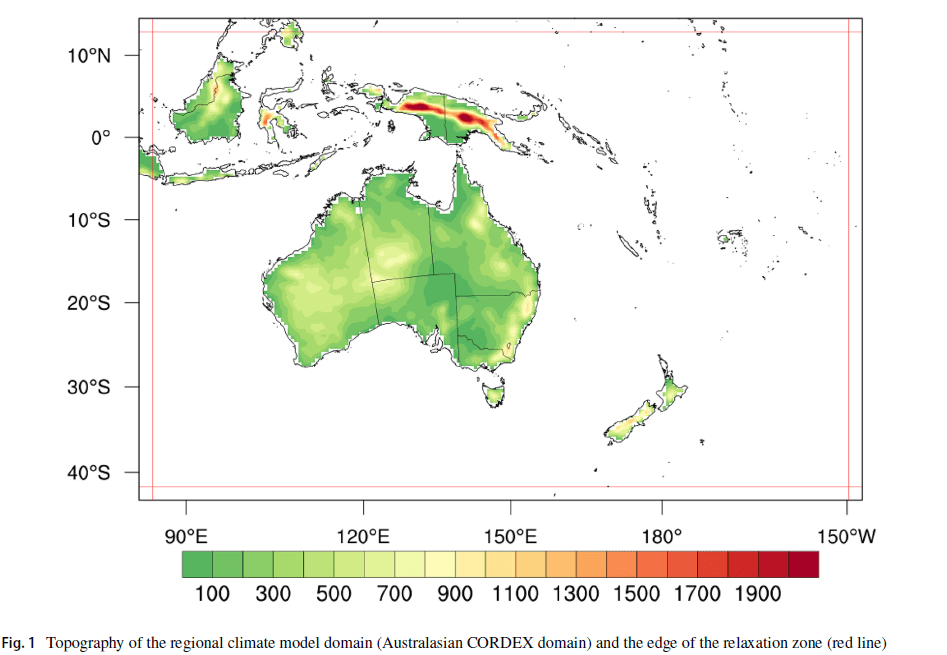
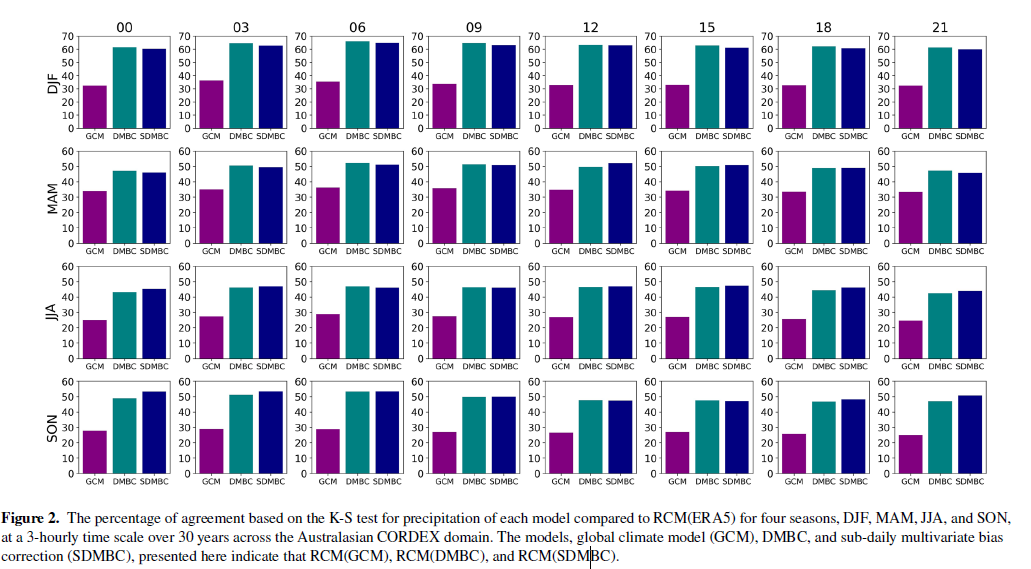
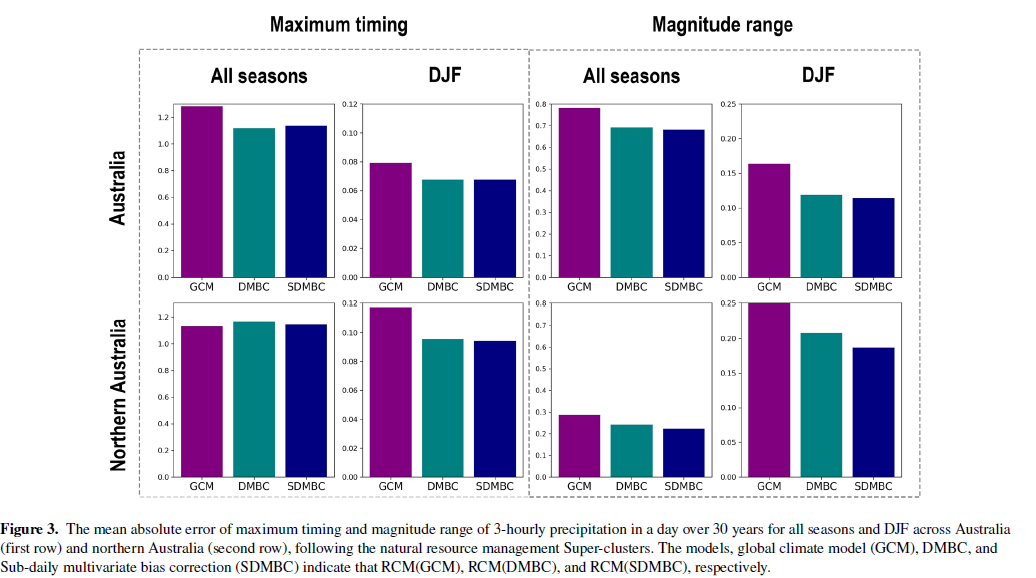
Global climate models have limitations in simulating precipitation characteristics at sub-daily time scales, leading to significant bias in capturing rainfall timing and magnitude in regional climate model (RCM) simulations that use global climate model data as input. Previous studies have applied various bias correction approaches to the boundary conditions of RCMs, but they often assume that GCM sub-daily rainfall patterns are simulated correctly, leading to a significant bias in maximum rainfall timing and magnitude within the domain. This study investigates the consequences of multivariate sub-daily bias correction on the boundary conditions in order to evaluate the model performance for short-term precipitation events. The results show that RCMs with bias-corrected boundary conditions exhibit improvement across Australia, especially in northern Australia, which regularly experiences intense sub-daily rainfall.
Concluding mark
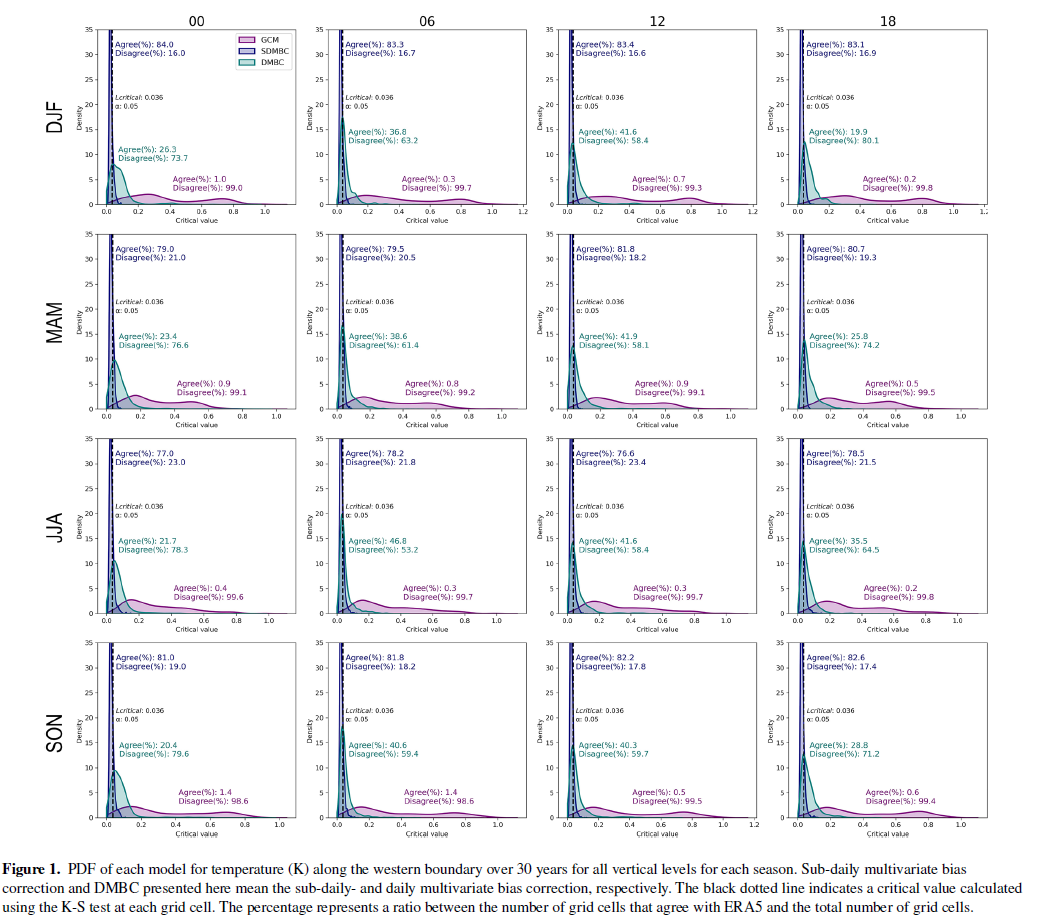
We conducted the first-ever study of how well more sophisticated alternatives for correcting systematic bias at the sub-daily time scale on RCM boundary conditions improve the diurnal precipitation patterns within the domain, particularly in northern Australia, where intense sub-daily rainfall is often present. The results demonstrated that sub-daily correction on the boundary conditions can improve sub-daily precipitation patterns and generally showed better performance, especially in northern Australia, which experiences a strong diurnal cycle in precipitation. Although sub-daily correction using QM was applied to the boundary conditions, the distributions of the bias-corrected variables were not perfectly aligned with the reanalysis data. This suggests that the multivariate bias correction may undermine the effects of sub-daily correction, as the daily bias-corrected variables are converted into 6-hourly variables using a fraction factor determined by QM prior to multivariate bias correction. Moreover, while SDMBC showed notable improvement in the lateral boundary conditions, its impact on the diurnal precipitation cycle was reduced far from the boundaries, indicating that the RCM plays a significant role in driving the output variables. Despite these factors, SDMBC of RCM lateral boundary conditions consistently produced the best-simulated climate within the RCM domain and should be considered for use within regional climate projection projects like CORDEX or NARCliM.
 EcoSphereYoung