Spatial, temporal, and multivariate bias in regional climate model simulations
Authors:
Youngil Kim, Jason Evans, Ashish Sharma, and Eytan Rocheta
Published year:
2022
Research purpose
It is well understood that systematic biases within a global climate model simulation can be passed into the input boundary condition of a regional climate model (RCM). To address this, many bias correction approaches have been used to correct the lateral and lower boundary conditions of RCMs, while assuming that each variable that makes up the lateral or lower boundary is independent. This study investigates the consequences of bias correction to assess whether the dependencies in time, space, and between variables are preserved. Using correlation length, it is shown that there is improvement in spatial and temporal dependence but not in inter-variable dependence which can produce a mismatch in the physical relationships in the simulated outcomes. A more physically consistent approach that considers the relationships between the variables is needed instead of the simplistic univariate correction procedures that have been used to date.
Concluding mark
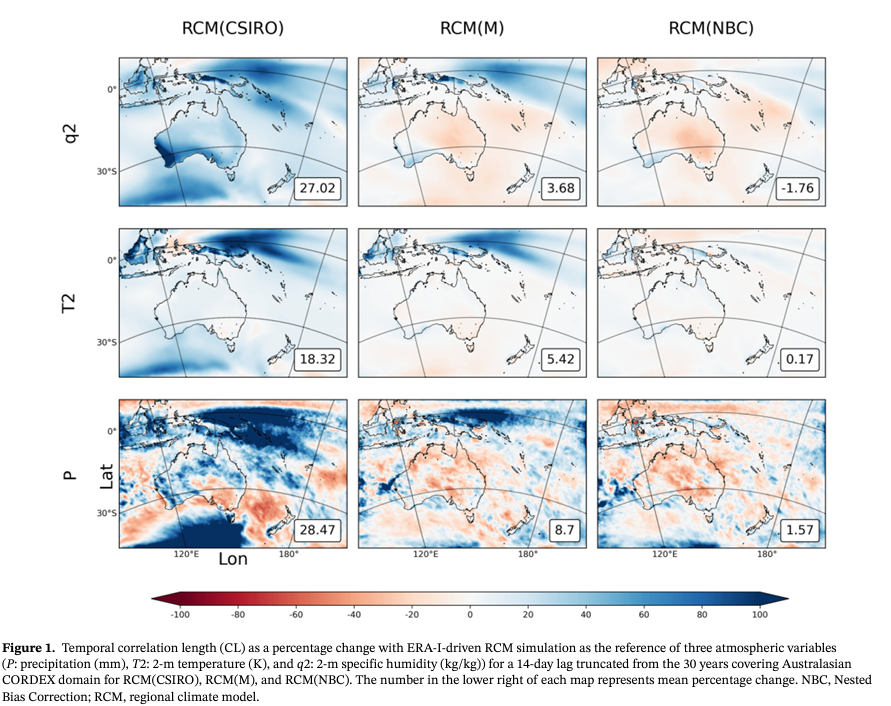
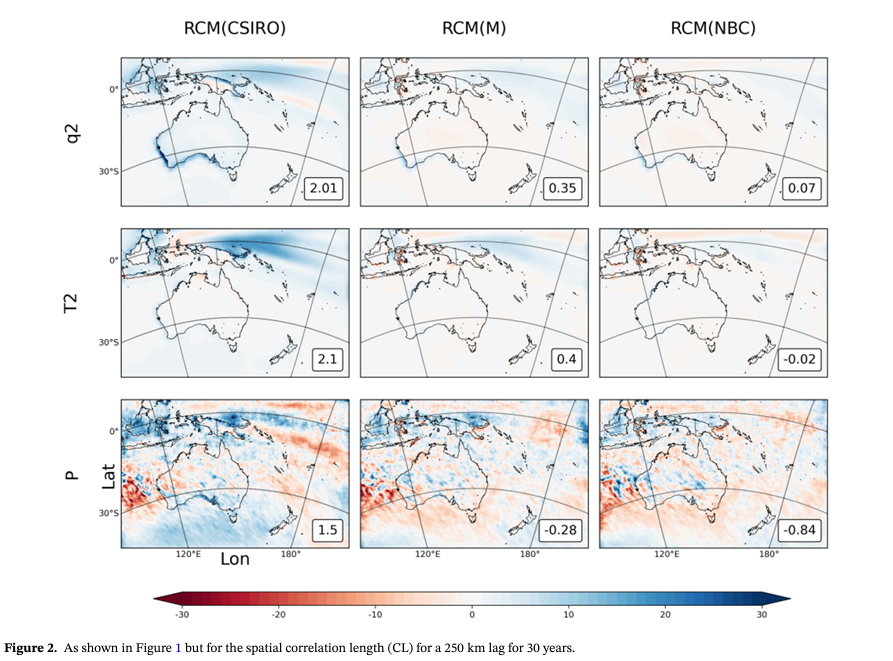
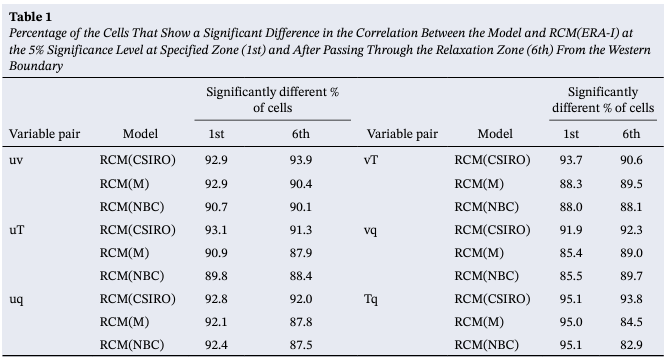
This study investigates the effectiveness of bias correction on Regional Climate Model (RCM) boundary conditions, specifically examining temporal, spatial, and multivariate dependencies in simulation accuracies. Since the atmospheric variables are known to have strong physical relationships, however, it is essential to accommodate the observed dependence across the variables when input to the RCM simulations. Given the importance of correcting the mismatch in dependencies between the model and observation, we investigated whether the model and bias correction can reproduce the “observation”, focusing on three aspects: temporal, spatial, and multivariate dependence. The research finds that RCMs with bias-corrected inputs better reproduce observed patterns over time and space. Specifically, nested bias correction, which adjusts for average conditions, variability, and time correlation, significantly improves these simulations. Mean bias correction shows some improvement for the mean percentage changes, while it lacks some ability to capture the temporal and spatial variability in some regions in the tropics. Interestingly, the study observes that RCMs can improve spatial patterns without regard to bias correction for input boundaries. This suggests that the models might adjust for some inaccuracies, pointing to the need for further investigation into their internal workings. Despite improvements, the study notes significant inaccuracies in simulating rainfall, highlighting the challenge of accurately capturing precipitation variability. This highlights the importance of pre-downscaling bias correction to remove errors from model inputs. Lastly, the study points out that correcting for one variable at a time doesn’t fully address the complex interplay between different atmospheric variables, especially for extreme events. It suggests exploring more comprehensive multivariate bias correction methods to tackle these challenges better.
 EcoSphereYoung