Development of a hybrid regionalization model for estimation of hydrological model parameters for ungauged watersheds
Authors:
Youngil Kim, Seung Beom Seo, and Young-Oh Kim
Published year:
2018
Research purpose
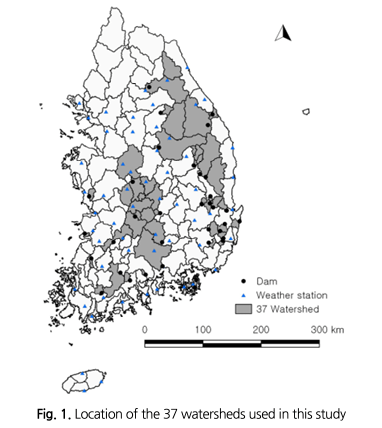
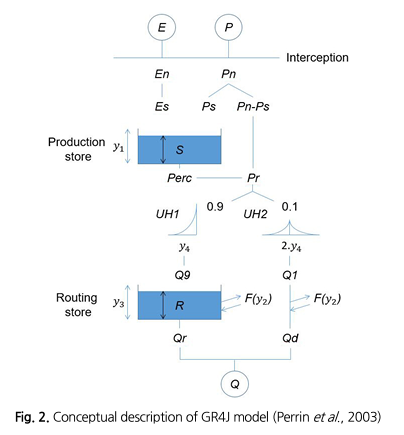
Numerous ungauged watersheds remain in Korea owing to limited spatial and temporal streamflow data with which to estimate hydrological model parameters. To deal with this problem, various regionalization approaches have been proposed over the last several decades. However, the results of the regionalization models differ according to climatic conditions and regional physical characteristics, and the results of the regionalization models in previous studies are generally inconclusive. Thus, to improve the performance of the regionalization methods, this study attaches hydrological model parameters obtained using a spatial proximity model to the explanatory variables of a regional regression model and defines it as a hybrid regionalization model (hybrid model). The performance results of the hybrid model are compared with those of existing methods for 37 test watersheds in South Korea. The GR4J model parameters in the gauged watersheds are estimated using a shuffled complex evolution algorithm. The variation inflation factor is used to consider the multicollinearity of watershed characteristics, and then stepwise regression is performed to select the optimum explanatory variables for the regression model. Analysis of the results reveals that the highest modeling accuracy is achieved using the hybrid model on RMSE overall the test watersheds. Consequently, it can be concluded that the hybrid model can be used as an alternative approach for modeling ungauged watersheds.
Concluding mark
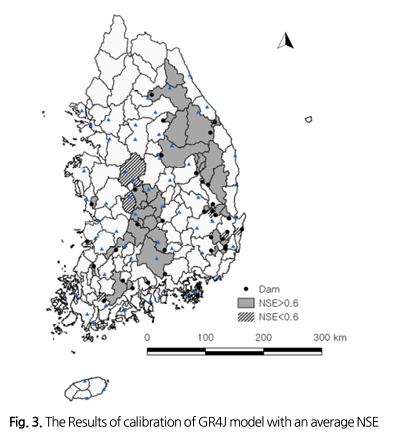
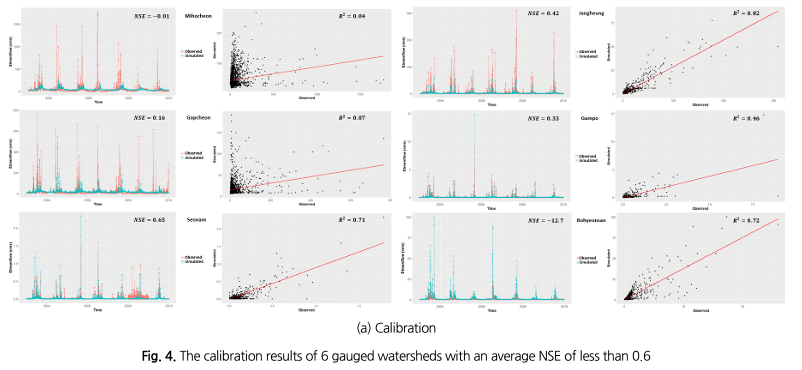
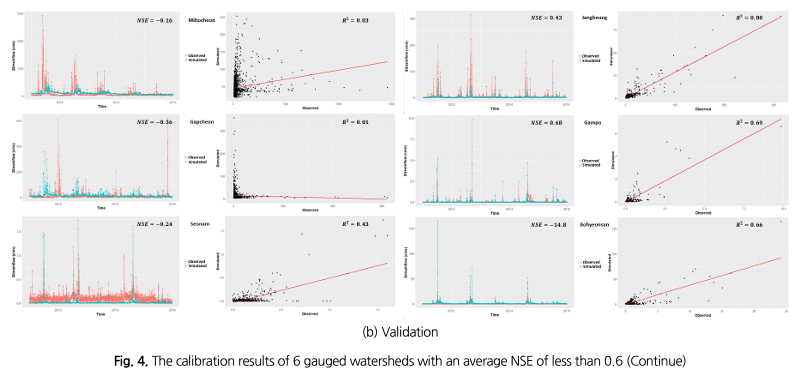
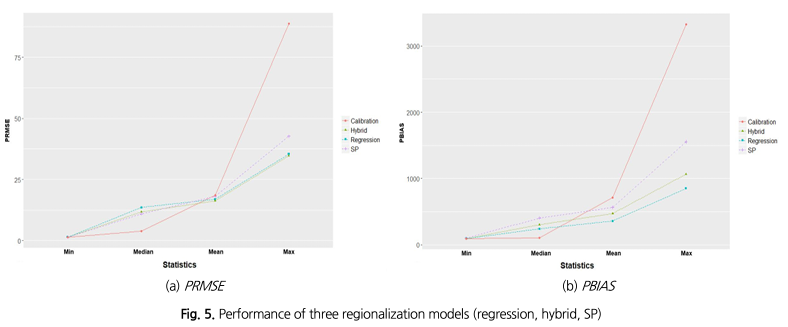
This study aimed to create a new hybrid model for estimating runoff in ungauged watersheds by merging regional regression and spatial proximity methods. This hybrid model overcomes the limitations of previous approaches by better representing variable relationships and basin characteristics, which enhances runoff simulation. The study involved 37 South Korean watersheds with sufficient data. We used stepwise regression to derive the final equations and developed a model for 31 watersheds that showed high suitability with NSE values above 0.6, then tested it on six others. The hybrid model showed the best performance in PRMSE, while the regional regression was better in PBIAS on average. The hybrid model could be a viable option for ungauged watersheds, but it sometimes underperformed compared to existing models. This could be due to removing important variables due to multicollinearity or the influence of high leverage points. To improve, selecting variables with high explanatory power and outlier consideration is crucial. The hybrid model’s fit was possibly affected by including all data outliers without prioritizing variable explanatory power. Hence, choosing the right variables is key to enhancing the model’s fit. The lower accuracy in ungauged watersheds used here may be due to poor calibration, suggesting a need for further studies using well-calibrated watersheds for comparison.
 EcoSphereYoung